

Navigating Temporary Repairs: Risks and Compliance Essentials Post Construction Codes (PCCs) API 510/570/653 define these as temporary repairs but a feature of ASME PCC-2 is that it provides technical details and leaves the user to decide themselves. What is temporary? There’s no agreed definition of temporary. The nearest is from API codes as ‘to the next maintenance/replacement opportunity’. Temporary …
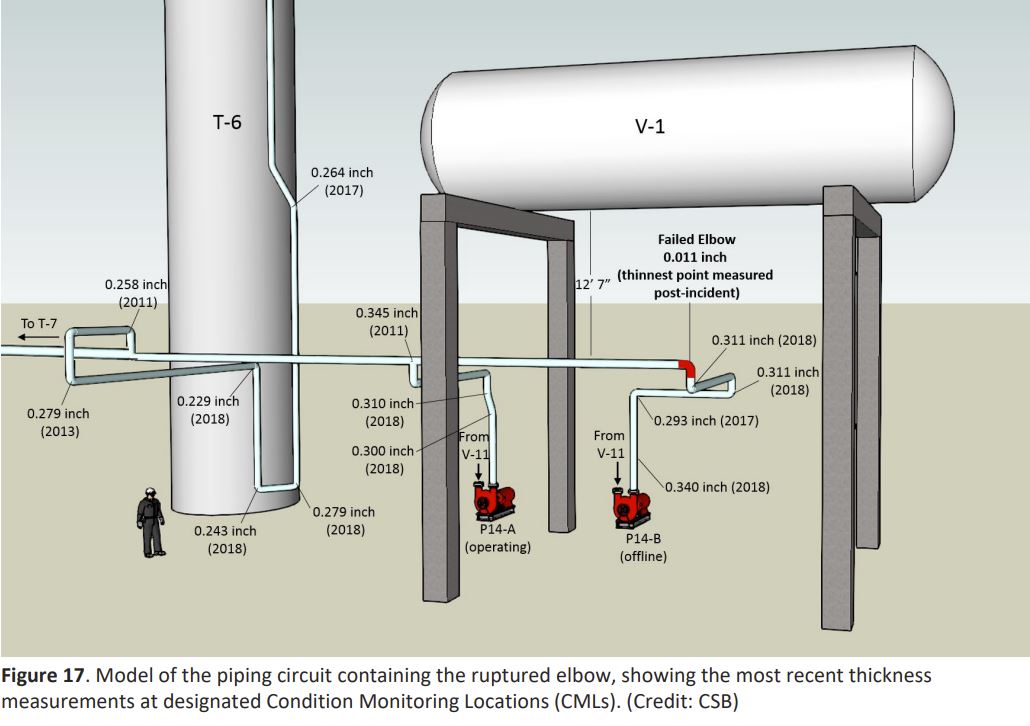
HF Damage Mechanisms – the threat to your assets. The US Chemical Safety and Hazard Investigation Board have issued the final report on a significant fire and related explosions that occurred in June 2019 at the Philadelphia Energy Solutions (PES) Refinery in Philadelphia, Pennsylvania (CSB). The cause of the accident, which shut down a refinery that could produce …

Sometimes, A Little Change Is A Good Thing Fitness For Service Training – API 579/ASME FFS-1 – must be up there as one of the most comprehensive and helpful resources out there in the world of technical codes and standards. First published in January 2000 it provides the refining and petrochemical industry with various methods for the reliable …

Fitness For Service – Local Metal Loss Level 1 Assessment. Part 3 of our 3 part series takes a look at the assessment of local metal loss. As we discussed in Part 1, there is strictly no definition of what constitutes local metal loss compared to general, so the accepted rule of thumb is to start with a Part 4 …

Fitness For Service General Metal Loss One of the most common damage classes (modes) found in static mechanical plant is metal loss. It can be caused by a number of damage mechanisms such as; -Atmospheric corrosion -Erosion -Sulphidation -Corrosion Under Insulation (CUI) -Microbiological Induced Corrosion (MIC) -Under Deposit Corrosion(UDC) -CO2 corrosion There are many more, and these can …

What are the PSSRs and what do they cover? The Pressure Systems Safety Regulations 2000 (PSSR) cover the safe design and use of pressure systems with the aim to prevent serious injury from the hazard of stored energy (pressure) as a result of the failure of a pressure system or one of its component parts. The regulations are …

This article ‘Back to basics – Material Properties’ covers the essential properties when considering asset integrity. Material science in itself is a huge subject, with endless reference books and academic courses that cover the subject. Only a high-level understanding will be provided in this article. Stakeholders should be concerned with ensuring pressure equipment is safe to operate and the …

Pressure Relief Valves – Pressure equipment requires protection from over pressurisation. A common way to protect vessels is the installation of a pressure relief valve. A pressure relief device is actuated by inlet static pressure and designed to open during an emergency or abnormal conditions to prevent a rise of internal fluid pressure above the specified design value. This device …

Corrosion Basics Part 1 Salt is bad for your health! – Corrosion basics Definition: Corrosion is the degradation of a metal by its environment–it literally means to “eat-away”. Most metals do not naturally occur as a pure metal. In their natural state, they exist in the form of oxides. These metal oxides (or other metal compounds) must be refined to …

Are you interested in Fitness for Service assessments? Try this question to test your knowledge. The Question Note, there’s only one answer. Fitness-for-Service assessments are carried out on pressure equipment or structural components that are corroded or damaged in some way. Looking at it from a code-related rather than practical viewpoint, what exactly is an integrity assessor trying to do …